

I paid Upwork over $5,000 in fees last year. And honestly? I’d do it again.
At the end of last year I pulled up my Upwork earnings report and one number stood out: over $5,000 in fees. That’s what I paid the platform just to work. To send proposals, take jobs, get paid.
I wasn’t angry about it. I’m still not.
Four years of full-time freelancing through Upwork, and that $5,000 reads to me less like money lost and more like rent. Rent for the setup that lets me work from wherever I happen to be (I currently happily live in Cambodia), with clients I actually want, on terms I set myself.
So yes. Still here. Still paying. Not going anywhere.
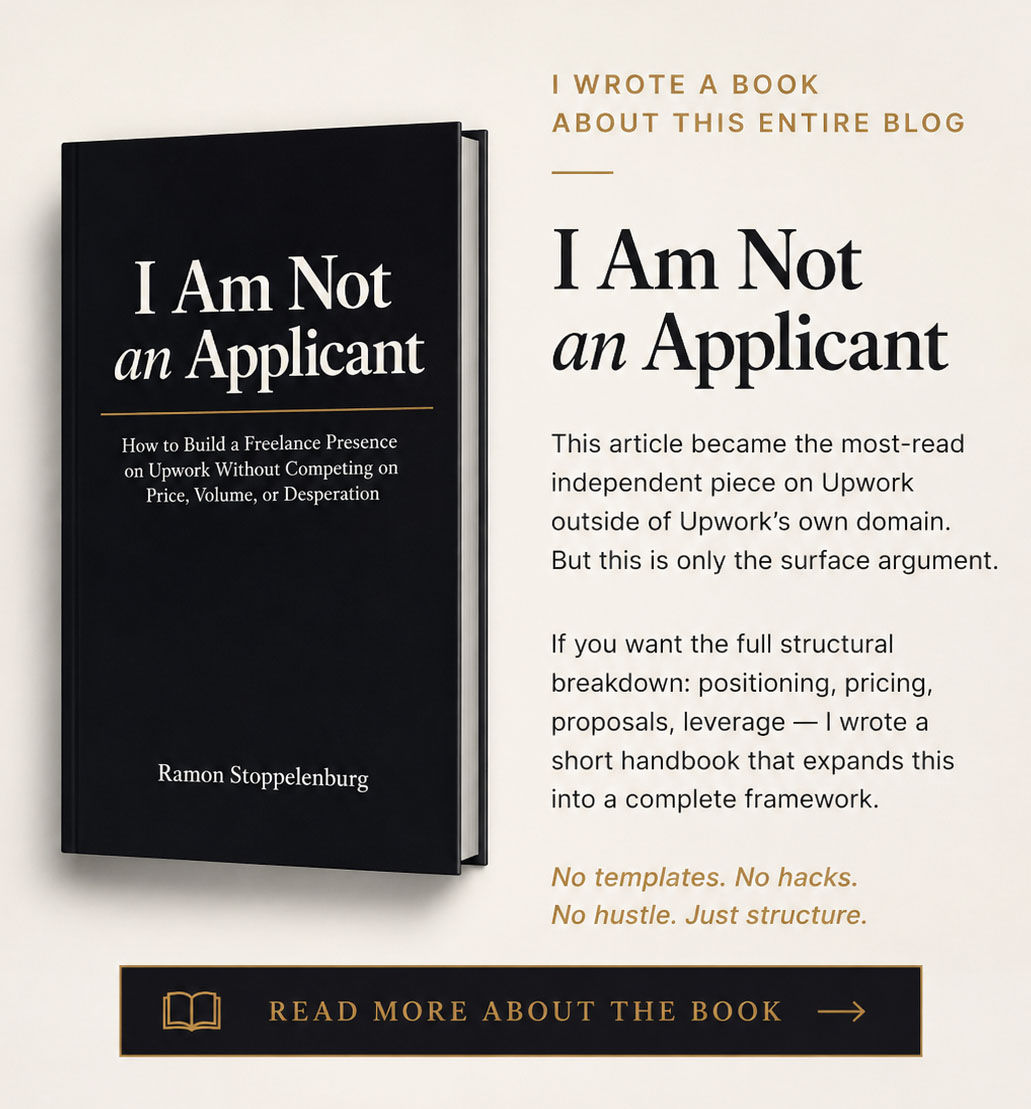
(Article continues below my book announcement.)
Upwork Gets a Lot of Flak
I’ve had people look genuinely puzzled when I tell them I still use Upwork. The fees. The competition. The whole race-to-the-bottom thing. And they’re not wrong that those problems exist — I’ve run into all of them.
My experience has just been different.
Not because I have some secret angle, but because I never treated the platform as a shortcut. I treated it like a slow build. No mass-blasting proposals. No copying templates. I figured out how to write a pitch that sounded like me. Then I kept showing up until that actually started working.
Once it clicked, Upwork stopped being a freelancing platform and started being infrastructure. The thing my work actually runs on.
Wait — what is Upwork?
Quick version, for anyone who hasn’t used it: Upwork.com connects freelancers with clients around the world. Writers, designers, developers, translators, marketers — if it can be done remotely, it’s on there somewhere.
The platform takes a cut — currently 10% to 15% depending on your earnings with each client. In exchange, they handle contracts, weekly payments, escrow, disputes, and time tracking if you want it.
Which means I spend my time doing the actual work rather than administrating around it.
Why I Stay: The Freedom Thing
I was never going to last in a normal job. My bio makes that fairly obvious. The daily commute, the same desk, asking someone’s permission to go eat lunch — all of that made my skin crawl long before I had a better option.
Freelancing through Upwork gave me a way out of it entirely. I answered a client message last year from a café partway up Kilimanjaro, between acclimatization days. I’ve edited documents on a balcony in Sri Lanka with the ocean in front of me. I’ve taken calls barefoot in Portugal after a swim. The locations change constantly; the work gets done regardless.
That’s not a side benefit. That’s why I’m doing this at all.
What I didn’t expect was how much it compounds. Four years in, I’m better at managing my time, sharper about which clients are worth taking on, and clearer on what I charge. I’m not burning out. I’m not dreading the week ahead. Whatever I’ve built here is actually mine.

The Work Itself
The variety has been one of the genuinely unexpected things about this. One week I’m translating a romance novel set in small-town Canada; the next I’m line-editing an investor pitch for a Berlin startup; the week after that a major streaming network drops into my inbox needing urgent Dutch legal document translations, yesterday if possible.
I’ve worked with CEOs, published authors, first-time entrepreneurs who built their whole business on a laptop. Some jobs last a day. Others have been going for three years straight with the same client, who by now just sends me things without much explanation because they know how I work and I know what they need.
That kind of relationship doesn’t come from a job board. It comes from showing up consistently and not cutting corners. I’ve also learned more about how different industries actually communicate — startups versus publishers versus legal versus entertainment — than I could have picked up in any single office over the same period.
The Part Nobody Mentions: Getting Paid
Off-platform freelancing has one recurring nightmare: the invoice that goes nowhere. You do the work, you send the invoice, and then you wait. A week. Three weeks. You send a polite follow-up. You wait again. Eventually you start wondering if you’re going to have to write it off and move on.
I spent years dealing with that before Upwork. I despised it.
In four years on the platform, I haven’t had to chase a single payment. The escrow system means the money exists before I start. When I deliver, it releases. If something goes sideways, Upwork support steps in. Even for urgent jobs — especially for urgent jobs — I wait until the contract is in place before I open a single file. The clients worth working with accept that without complaint. The ones who push back on it are usually the ones who’d disappear on payment anyway.
Not having to send those follow-up emails anymore — that alone is worth a lot.
About Those Fees
Upwork runs a variable service fee, currently between 0% and 15% depending on your lifetime billings with a given client. Last year that added up to over $5,000 out of my earnings.
For context: that’s roughly two years of beach apartment rent in Sri Lanka, where I’ve stayed more than once. Real money.
But that money bought access to a pipeline of work I didn’t have to generate from scratch. It bought a profile with enough reviews that new clients don’t need convincing. It bought functioning payment infrastructure across multiple currencies and countries, which is not a small thing when you’re working with clients in the US, Germany, the Netherlands, Australia, and Cambodia in the same month.
Starting out, the platform credibility matters more than people admit. You’re not cold-pitching strangers and hoping they’ll trust you. The track record is visible. That matters.
Would I rather keep that 10%? Yes, obviously. But the life this setup enables isn’t one I’d trade to save on the fee. The percentage isn’t the point. What it actually buys is.
If this resonates, understand this: Upwork is not broken. But most freelancers are playing it wrong — operating as applicants in a marketplace that rewards posture, not volume.
I wrote a short handbook explaining exactly how the game works, and how to stop competing on price, visibility, and desperation. You can read about it here.
It’s Not All Fine, Either
The first few months were genuinely rough. I sent proposals that got no response at all. Not a rejection — just silence. That goes on long enough and you start questioning whether you’ve miscalculated something fundamental.
And even now, some clients arrive with a firm idea that experienced work should cost entry-level rates. That never really stops; you just get faster at recognizing it in the first message and moving on.
The platform itself has its own frustrations. Profile visibility shifts with no clear explanation. Algorithms that seem to reward activity metrics you can’t fully control. One month you’re getting invitations; the next month nothing has changed on your end but the flow has dried up.
There’s also the reality that this is a business, not a passive setup. Upwork handles contracts and payments. Everything else — managing your schedule, keeping your profile current, responding to clients quickly, knowing when to push back on scope — that’s yours. It requires actual attention.
What changes over time is that you stop hoping it gets easier and start getting better at it. You learn the difference between a client who’s difficult and one who’s genuinely worth the difficulty. You get sharper about what you charge and why. The platform that felt unpredictable in year one starts to feel workable, then reliable, then genuinely yours.
For Anyone Starting Out
Upwork isn’t frictionless. The first few gigs take real effort, and the competition is actual competition. But once you find your footing, the infrastructure holds.
If you’re weighing whether it’s worth starting: it was worth it to me when I had nothing on my profile and no idea if it would work, and it’s still worth it now. That’s about as honest an answer as I can give.
If you’re already on Upwork and stuck, I’m happy to compare notes. Get in touch. I remember what those first months of silence felt like, and I’m not going to pretend I figured everything out immediately.
If you’re brand new and want step-by-step onboarding advice: the Upwork website has thorough resources for that, and it’ll serve you better coming from them directly than from me. Once you’ve landed your first few jobs and you’re trying to figure out what’s next — that’s when we have something to talk about.
Ramon.
This article was the spark.
The full argument — how to fix your profile, stop competing on price, build leverage without flooding the system with proposals — is in my short handbook:
I Am Not an Applicant
How to Build a Freelance Presence on Upwork Without Competing on Price, Volume, or Desperation
Before you buy more Connects, read this first.
I signed up for UpWork to be a freelancer artist, I see several opportunities that interest me. However, it mentions to purchase Connects. This is the part where I began to doubt this. If assuming correctly, I need to buy connects in order to apply for freelance jobs? Does the company not already take 20% of what you make?
Speaking of which, how are you paid? I am positive you don’t provide personal bank info to anyone on there
Upwork does use a system of “Connects” that you need to use in order to bid on jobs. The number of Connects required varies based on the complexity and pay rate of the job. You get a bunch of them when you just sign up and if you have a complete profile, you also get a bonus of them per month.
I sometimes spend a dozen of dollars on them per month. It allows me to just propose to those jobs that really fit me.
Upwork does take a percentage of your earnings, yes. But that’s also my security for being paid weekly (!) and I don’t ever have to hassle with clients over payments and conditions. I work when a milestone has been activated or a contract is made.
As for how you get paid, Upwork offers a variety of payment methods, including PayPal, Payoneer, and direct bank transfer. You only enter this once, so Upwork pays you. Clients pay Upwork to pay you in the end. No client ever sees your banking information online. That’s also a protection thing. You never have to invoice a client either.
Thank you, Ramon – this is great information! I’ve been a freelancer off and on for a while, but wanted to move in a more “stable” direction. Your insight on how Upwork functions is a huge help – now I’m all set to give it a go!
Last year 2024, I was only able to land one job. Indexing a game manual using microsoft word although I have been sending proposals as a technical writer right and left. Is the market getting that competitive or am I doing something wrong. I have a top rated badge, my portolio is overflowing, my qualifications are impeccable, I have a video on my profile. I guess the competition is just too much.
Please share your opinion and maybe some suggestions. And thanks for sharing your time.
It sounds like you’re doing all the right things in terms of qualifications, portfolio, and profile optimization! That’s great, and it shows you’re committed to getting noticed on Upwork. But yes, the competition in freelancing can definitely feel tough, especially in technical writing where there are a lot of talented professionals.
Here are a few suggestions that might help boost your chances:
Refine Your Proposals: Even with a strong portfolio, proposals need to be tailored to each job. Take time to truly understand the client’s needs and highlight specific experience you have related to the task. Show how you can solve their problem, not just how you’re qualified. Clients read the first two lines and decide then if they want to read more.
Be Strategic with Your Niche: Sometimes, broad categories can lead to a lot of competition. If you specialize even more (e.g., game manuals, medical writing, or tech documentation for certain industries), it might help you stand out more. People are often willing to pay more for specialized knowledge.
Leverage Client Feedback: Since you’re Top Rated, use that to your advantage. Be sure to ask satisfied clients for testimonials, or better yet, referrals to other potential clients. Social proof is powerful!
Keep Your Profile Active and Engaging: Regularly update your profile and ensure it reflects your most recent work. An active profile can increase your visibility.
Timing and Patience: The freelancing world can sometimes require more patience. Keep applying, keep improving your proposals, and stay visible.
Competition is real, but with persistence and continuous tweaking of your approach, you can definitely see the results you’re hoping for. Keep at it!
Good luck, Jerry! You’ve got the right mindset.
I would definitely read this once again after I would start applying on Upwork. And yes, I agree with every word what you have said in this article and I understand every feeling that you have expressed. Freelance is a freedom and that is the thing you have to earn, so thank you for your wise words!!!
Hey, thanks for your article. I recently got on Upwork. From my understanding it’s not somewhere you go when you are starting from scratch. You need some money to invest before you even have a chance of making any.
As a freelancer that is usually how it goes anyway. You need gas, bus fare, or some kind of transportation just to get in front of potential clients every day. I am still trying to figure out if overall it is worth it. It is definitely annoying to see all these clients in my field needing help and not be able to talk to them or reach out directly without connects and a tailored resume.
I am in the first month, and the question “is this worth it?” crosses my mind a lot. I have sent 10 proposals and spent over 200 connects. I even bid higher to get on top but still got outbid. Out of those 10, only 3 have even been viewed, and none got feedback. That is the part that sucks. More than 120 connects are tied up in proposals nobody has looked at.
It feels strange to invest money and not know how much you will need to put in before you get some back or actually start profiting. I read your article and wanted to ask if you remember how much you spent on connects before you started seeing a return. I know the 10 percent fee is there, but do you also count the connect costs as part of that fee?
Good question. I currently spend about 100 connects every few months, which is not that much. But I have also been on the platform for years now, to see what works, learned when I should apply or not.
And I do not believe in the bidding war on a job. I know clients that totally disregard the proposal one on top and do see the other applications too. If I am better than the highest bidder, I will get the job – that’s my mantra. So don’t bid and don’t apply for projects that cost you over 20 Connects to apply to. Never worth my time.
Just read your article and honestly I am inspired, thank you!
So I have this small question, and maybe you had this question many times.
I have no experience at all in freelancing. My skill is also not much in regards to commonly required in freelancing industry such as typing, contect creator, digital marketing and so on. So, is it a must to have some solid skill for someone who want to try freelancing for the first time? Or maybe it is increased overtime?
Because I want in some point, to try and start my freelancing career, and maybe it will become my full time job.
Thank you in advancce and pardon my English, its not my first language
Your English is perfectly understandable, no need to apologize. And your question is very good.
To answer it: freelancing doesn’t require you to start with a “perfect” skill set. What it does require is that you have something useful to offer clients, even if it is small or basic at the beginning. Many successful freelancers started with simple skills, things like data entry, transcription, basic research, or translation, and then gradually developed stronger, higher-value skills over time.
It is not a must to have solid, advanced skills before you begin. What matters more is that you start with honesty about what you can do right now, deliver that work carefully and reliably, and then reinvest your time in learning. As you get feedback from clients and see what jobs are in demand, you can study and practice new skills. For example, graphic design, writing, coding, digital marketing, or translation. Over months or years, your profile grows stronger and you can raise your rates.
If your goal is to make freelancing your full-time job, think of it like building a house. The first bricks may be small and simple, but each project adds another layer of experience. The important thing is to start somewhere, even if it feels basic.
Upwork is great until you get an unethical company, then there is no protection for the freelancer, only the company. I worked hard, 25+ hours in a week only to not get paid because the company lied and told the scope was not delivered. Upwork did a internal challenge but did not consulted me on anything.
Scammer Freelancer from Upwork!
Several months ago, our employee contracted a freelancer named —- —— from the United Arab Emirates. In our communications with this freelancer, it was clearly stated that she was publishing a media article about one of our company’s technologies. After one publication by this freelancer, the media platform’s author deleted it due to unprofessional writing. The freelancer claimed it was beyond her control, but misappropriated the money transferred to her as a deposit. She then began claiming she had completed her work. We have retained all correspondence! BE CAREFUL when working with UPWORK freelancers!!!
The Upwork support team apologized for the inconvenience and THAT’S IT!!!
Thanks for sharing your experience. I’m sorry to hear that this happened. It sounds frustrating. Unfortunately, like on any large freelance platform, experiences can vary widely depending on the freelancer and the client.
Upwork does have dispute mechanisms and escrow protection in place to help prevent situations like this, but they rely on clear contracts, communication, and proper use of milestones. For anyone reading this: always make sure to keep all work and payments within the Upwork platform, use milestones for every stage of a project, and check a freelancer’s reviews and portfolio before hiring.
This blog aims to share both the opportunities and challenges of remote freelancing, and comments like yours remind everyone why trust and professionalism are so essential on both sides.
Love this it’s very affirming. I’m also top rated, been on the platform years and it’s my main outreach/lead strategy along with referrals. I was almost giving up, after recently seeing people bidding 100+ connects for jobs, and still averaging around 20 proposals a month, converting to maybe 2 discovery calls. I still think it’s worth it but it’s getting way more competitive! Thanks for this!
I wanted to hire someone through Upwork.. Unknowingly, when I asked how the person was to be paid through various ways, Upwork decided that I was trying to contravene them and has blocked me. In no way was I attempting to contravene. When I appealed, I once again was blocked. Fortunately, I changed free lance platforms and engaged someone else through another site that was much more friendly and easier to deal with. Too bad the free lancer lost me as a client.
Thanks for sharing your experience and I’m really sorry to hear that happened to you. Upwork can be pretty strict around anything that *sounds* like moving payments off-platform, even when people are just asking innocent questions. Their automated moderation doesn’t always give room for nuance, and that can definitely create frustration.
It’s interesting how different people’s journeys on Upwork can be. For some, like you, the system gets in the way. For others (like me), it becomes the framework that supports my entire career. Neither experience is wrong: they just show how varied this world of online work really is.
And just a friendly heads-up: it’s freelancer (one word, always been). Always good to get that right before hiring the next one.
I hire on Upwork and it’s a challenge to consistently find good talent, and avoiding freelancers that know fully well how to game the platform. The ratings, hours, and billing never seem to jibe with reality, fyi.
After writing this article, I expanded the argument into a short handbook called “I Am Not an Applicant”. It covers positioning, pricing, and the structural mistakes freelancers make on Upwork.
For those asking “what now?” — that’s the answer.
I understand that many freelancers are frustrated with platforms like Upwork, especially with the increased competition and fees in recent years. The market has certainly become tougher.
That said, dismissing everyone else’s experience as luck or calling people names doesn’t really move the conversation forward. My article simply reflects my own experience on the platform, which has had both good and bad periods. For some people it works, for others it doesn’t.
Thank you for sharing your experience. Losing that amount of money while projects stall must be extremely frustrating, and it’s understandable that it leaves a negative impression of the platform.
At the same time, it’s worth noting that Upwork itself is only the marketplace. The quality of the outcome depends heavily on how projects are structured and managed. Hourly contracts without clear milestones, regular check-ins, and defined deliverables can unfortunately lead to the kind of situation you describe, especially in complex development work.
Many companies do have positive experiences on Upwork, particularly when they start with small test projects, work with fixed milestones, and closely review progress before scaling up collaboration. But your warning about monitoring hours and verifying progress is certainly sensible advice for anyone hiring remotely.
I hope the dispute process helps you resolve at least part of the issue, and thank you again for adding your perspective to the discussion.
Upwork really cost the freelancer and the company. I have worked for many years and I am unhappy with upwork.
My success score is incorrect and they do not care.
I understand the frustration. When you’ve worked hard on the platform for years, it can be discouraging to feel like the metrics don’t reflect the reality of your work. The Job Success Score especially can feel opaque, since it includes private feedback that freelancers never get to see.
That said, it’s still one of the few platforms where freelancers can consistently connect with international clients, so many of us keep trying to make it work despite the imperfections. Hopefully Upwork continues improving transparency around scores and feedback, because both freelancers and clients benefit when the system feels fair.
Hello, I hope you are doing well.
I really enjoyed reading your post.
I also work on Upwork, and I am writing this because I have a question.
“So don’t bid and don’t apply for projects that cost you over 20 Connects to apply to.”
I saw a phrase like that in your post, but I don’t quite understand what it means.
I almost always use Boost to get my proposals ranked.
Doing so usually ends up using over 50 Connects.
I would appreciate it if you could share your experience with me.
For reference, I work in the software development field.
What I meant with that line is less about a strict rule and more about discipline. Connects are your budget, and like any budget, they need a return. When a single proposal starts costing 20, 30, or even 50+ Connects (because of boosting), the odds are already stacked against you—especially in competitive categories like software development.
Boosting can work, but it often turns into an arms race. You’re not just competing on quality anymore, you’re competing on how many Connects you’re willing to burn. And the problem is: even if you land one job, the cost per hire can become unsustainably high over time.
From my experience, a few things matter more than boosting:
Applying early, before a job gets flooded
Being selective (only jobs that really fit you)
Writing a sharp, tailored first 2–3 lines (most clients don’t read beyond that unless hooked)
Building a strong profile so clients come to you instead
If you’re consistently spending 50+ Connects per proposal, I’d seriously track your return: how many of those actually turn into paid work? If the numbers don’t make sense, it’s worth scaling that back.
In short: I’d rather send 5 highly targeted, well-written proposals at 10–15 Connects each than gamble everything on one boosted bid.
Curious: are you seeing a solid ROI from boosting, or does it feel more like you have to do it to stay visible?
I have been on and off on Upwork for 10 years. I have 100% Job Success and Top Rated status. What Upwork is doing is pure thievery.
1. jobs write 50+ offers, in reality, it is 100+
2. you pay to make an offer, and the client opens 5–6 of them
3. on top of that, they enabled boosting to make your offer less visible
4. you pay for a visibility badge
5. if you wish to see the actual number of proposals and how many are opened, you need to subscribe and pay more
6. base connects are not refunded even if the job is abandoned or never reviewed
You’re not wrong to be frustrated. What you’re describing isn’t a small tweak to the system, it’s a structural shift in how Upwork makes money, and it’s hitting exactly the people who used to rely on it most: experienced freelancers with solid track records.
The proposal inflation is real. When a job shows “50+ proposals,” it’s often already well past the point where your chances are meaningful. Add paid connects, boosting, and visibility badges, and it stops feeling like a marketplace and starts feeling like an auction where freelancers are bidding for attention rather than being evaluated on merit. That changes the psychology of the platform entirely.
What makes it worse is the asymmetry. Clients can disappear, never open proposals, or post vague jobs without consequences, while freelancers carry all the cost. Charging for insight into basic data like proposal counts and open rates only deepens that imbalance. It’s not just monetization, it’s opacity as a business model.
At the same time, I think there’s a hard truth many of us are slowly accepting: Upwork is no longer designed to be a reliable primary income source. It can still work, but increasingly as a lead generator at best, not a foundation. The freelancers who seem to be doing well now are either highly niche, extremely fast to respond, or already pulling clients off-platform into longer-term relationships.
Curious how you’re approaching it now. Are you still actively bidding, or have you started shifting your focus elsewhere?
I used to think the same about Upwork until recently.
Built up solid work, good clients, everything going well. Then got permanently suspended after using a VPN during a live client call to test access to a US-restricted system, exactly as the client requested.
Provided full video and transcript showing the context. Still upheld as a “final decision” with no clear explanation.
Not saying it doesn’t work for some people, but experiences like that definitely make you question how fair and consistent the platform actually is. Also fee paid in 18 months $20,000 earning $200,000 JSS 100% 5 star 40+ clients but account closed over night with no recourse so be very wary of using this platform as it may all end with no head s up and once an account is disabled you as a human being can never go back to Upwork. EVER.
Pingback: Vale a Pena Começar no Upwork em 2026? A Realidade
Pingback: Top Freelancing Platforms for Beginners to Start Earning in 2026 - Awesome Outsourcing
I’ve been on work for a couple years but really been hitting the ground running trying to get clients. I’ve done some contracting work outside of work but because those clients are not through up work people don’t think I know what I’m doing. I’ve submitted over 70 proposals in the past four months I Taylor every single sub submission. I spent hours of my days going through and vetting and being strategic like you said.
I’ve yet to have any luck I don’t really know where to go from here. You talk about the fluidity of movement throughout the world and that’s exactly what I’m looking for. Smart I’m knowledgeable in the area that I specifically tailored myself to you, but I don’t seem to be getting anything.
Tayilar, I completely understand the frustration. And honestly, 70+ carefully tailored proposals over four months tells me the problem probably isn’t that you’re not putting in the work.
One thing I would look at is whether you’re trying to prove your expertise *inside* Upwork rather than using your existing contracting experience as the proof. Clients don’t necessarily care whether the work came through Upwork. If you’ve done the work successfully elsewhere, that is experience — and you should be presenting it that way, with specific examples, outcomes, testimonials if you have them, and a portfolio that makes it immediately obvious what you can do.
I’d also stop measuring progress purely by proposals sent. If you’re consistently getting no replies, that’s useful information: something in the positioning, profile, portfolio, proposal opening, or the jobs you’re targeting needs to change.