Upwork is not a job board.
It is a perception marketplace.
Upwork is just the example. The real subject is how professionals position themselves in crowded marketplaces.
Most freelancers on Upwork are not failing because they are not good enough. They are failing because the market cannot tell them apart — from the hundred other profiles in the same search, at a lower rate, with more reviews, willing to start immediately.
The instinct is to try harder. More proposals. Better opening lines. A rate adjusted down just enough to compete.
That instinct is the trap.
Clients are not evaluating you deeply. They are scanning for signals — in seconds, often before they have read a single word of your proposal. Your rate is a signal. Your positioning is a signal. The way you write is a signal. Even what you decline to say is a signal.
— from the IntroductionThe freelancers who understand this operate on a different plane from those still competing on price and volume. They are not louder. They are clearer. And clarity is what converts.
Legibility matters more than talent in crowded environments.
— Part I: Why You're InvisibleFive parts. One structural shift.
Introduction
The Begging Economy
Why capable professionals become invisible — and how the platform's architecture makes the wrong response feel logical.
Part I
Why You're Invisible
The triage window. How clients filter in thirty seconds. Why flexibility signals the absence of expertise rather than range.
Part II
The Begging Economy
How the platform produces volume behaviour — and why desperation leaks into language even when you try to conceal it.
Part III
Strategic Proposals
Proposals written from a defined identity do not persuade. They confirm. The difference between a performance and a signal.
Part IV
Pricing as Power
Your rate is not a calculation. It is the single most visible signal on your profile. What holding it — through the silence — communicates.
Part V + Final
Building Leverage & The Posture Shift
From finding jobs to building a client base. Clarity compounds. Vagueness compounds in the opposite direction.
Read this before you buy Connects.
I'd been on Upwork for eight months, sending forty proposals, landing three projects. After reading this ebook in one sitting I rewrote my profile. Within two weeks I had two direct invitations and landed one at a rate I'd never dared quote before. This is the true value of buying 200 Connects on Upwork. Bloody read this first.
Freelance copywriter, United Kingdom
The chapter on pricing alone justified the cost. Every senior freelancer I know who is struggling is struggling because of what this book diagnoses.
Brand strategist & UX writer, Netherlands
I stopped adjusting my rate, stopped broadening my profile, started being more specific. My pipeline looks different now.
Technical writer & translator, India
★★★★★
I just downloaded your book yesterday and found it deeply helpful, impactful, & encouraging. Thank you so much for sharing your wealth of insight with others and God bless you sir.
Full Stack Creative, Minneapolis, USA
"Clients do not hire adjectives.
They hire outcomes."
Most freelancers on Upwork describe themselves the same way: reliable, detail-oriented, passionate about delivering results.
Those words feel professional. In reality, they make profiles indistinguishable.
Part I — Why You're Invisible
Most freelancers struggle not because they are incompetent but because they are indistinguishable. They describe themselves with the same language as everyone else. "Reliable." "Detail-oriented." "Passionate about delivering results." These phrases are so common they have become invisible. They do not differentiate. They do not signal authority. They fill space.
There is a specific reason this language dominates: it feels safe. If you describe yourself as reliable, no one can accuse you of overclaiming. If you say you are passionate, you have not committed to anything specific that could be tested and found wanting. This language is chosen for its defensibility, not its clarity. And defensible language, in a marketplace built on rapid signal-reading, is functionally useless.
Clients do not hire adjectives. They hire outcomes.
Consider the difference between these two profile summaries. The first: "I am a detail-oriented, reliable freelancer with five years of experience in content creation and social media management. I am passionate about helping businesses grow their online presence."
The second: "I write in Dutch and English for professional audiences. My background is in editorial work and cross-cultural communication. I help organisations say the right thing to the right people in both languages."
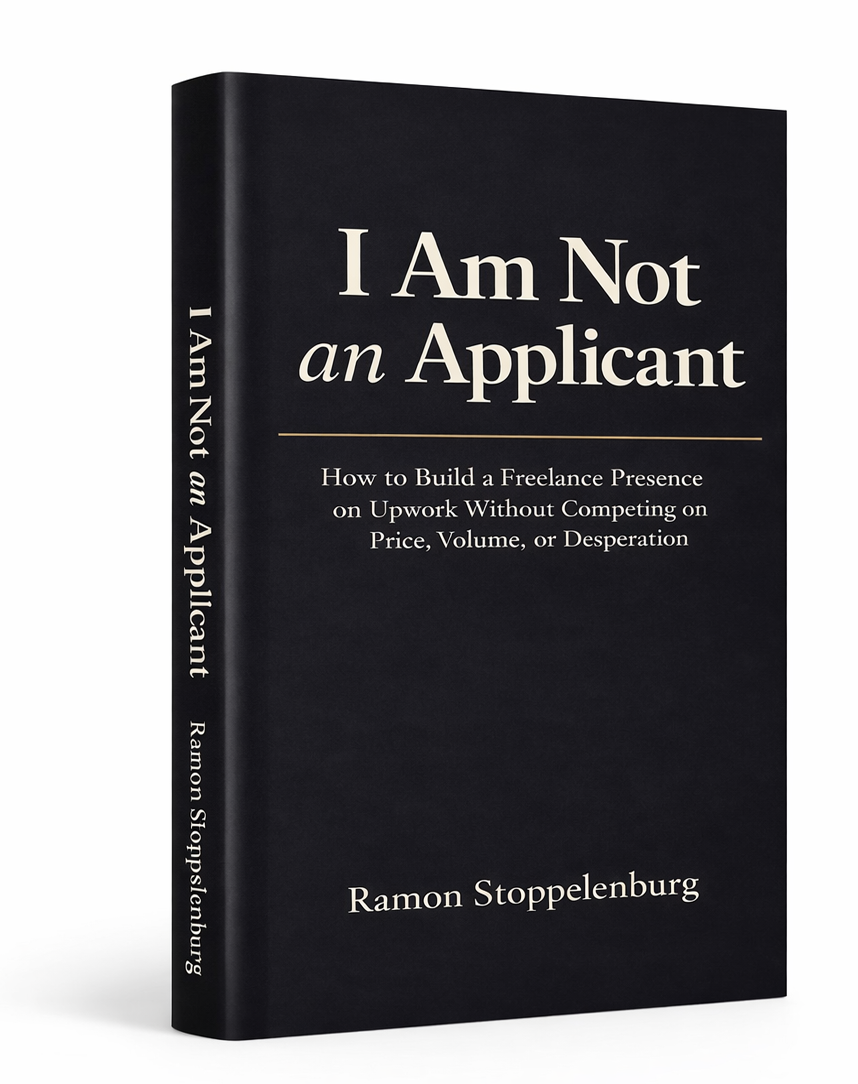
I Am Not an Applicant explains why capable professionals become invisible on freelance platforms — and how positioning, pricing, proposals, and leverage change the game entirely.
Get the book — US$ 9.99It will not work for everyone.
It is not meant to.
This book is for you
- You have sent proposals and received silence
- You have lowered your rate and felt the problem get worse
- You suspect the issue is positioning, not effort
This book is not for you
- You want copy-paste templates
- You believe the platform is entirely rigged
- You want reassurance rather than structure
The first pages are free.
Read it before you decide.
Introduction: The Begging Economy
Read the first pages of the opening chapter online, or download it as a PDF. No email required.
Before you decide.
The principles apply most directly to Upwork, because that is where the application mindset is most visible. But the structural shift — positioning, pricing as signal, proposal posture — applies to any freelance marketplace where you compete through proposals.
If you are brand new and still learning how the platform works, parts of this may feel uncomfortable.
If you have sent 20 proposals and felt invisible, it will make sense immediately.
Both. The first part explains the structural problem. The second translates it into proposal logic, positioning, pricing, and client selection.
You will not find templates. You will find decision criteria.
No. It will change how you approach opportunities. That usually changes outcomes.
It is concise by design. Clear enough to read in a few hours. Dense enough to rethink for longer.
You receive a digital edition suitable for reading on desktop, tablet, or e-reader. No physical copy.
If you read it carefully and genuinely believe it offers no structural value, send a short email explaining why.
That conversation is more important than $9.99.
Because it costs less than the Connects many freelancers waste applying from the wrong position.
I Am Not
an Applicant
How to Build a Freelance Presence on Upwork Without Competing on Price, Volume, or Desperation
Get the book — US$ 9.99One month of random Connect spending costs more than this book.
Buy this first.
Instant download · Read on any device