Posts in Tips

Why Most Freelancers Become Invisible on Upwork

Most freelancers do not fail on Upwork because they lack skill. They fail because they become invisible. And there is a difference worth understanding.

Browse the platform for ten minutes and you will see what I mean. Hundreds of profiles offering writing, design, translation, development, marketing. Many of them competent. Many of them experienced. Most of them never hired. Not because the platform is broken or clients are unreasonable, but because Upwork operates on a logic that most freelancers never quite grasp.

Upwork Is Not a Job Board

The default assumption is that Upwork works like a traditional job board: a client posts a project, freelancers apply, and the most qualified candidate wins. This is a reasonable assumption and it is almost entirely wrong.

Upwork is a perception marketplace. Clients are not reading every proposal carefully. They are scanning. They open a listing and within minutes they are looking at dozens of profiles, clicking through quickly, filtering on signals that reduce their uncertainty rather than criteria that measure skill. The question they are actually asking is not Is this person qualified? It is something closer to Does this person look like the kind of professional who will solve my problem without creating new ones? That question gets answered in seconds, and usually before anyone has read a single work sample.

The Compression Problem

Entering Upwork compresses your professional identity. Years of experience, entire bodies of work, hard-won specialisations: all of it reduced to a headline, a profile description, a rate, and however many reviews you have managed to accumulate. Whatever you have built elsewhere has to survive that compression intact.

Most freelancers make this worse, not better. Their profiles reach for language that sounds professional but communicates almost nothing: reliable, detail-oriented, passionate about delivering results. These phrases appear on thousands of profiles. They feel safe because they are difficult to argue with. But they are also impossible to distinguish from each other, and a client scanning twenty proposals in the same afternoon is not going to slow down for language that every other applicant is also using.

The problem is not that these things are untrue. The problem is that they describe inputs rather than outcomes. Clients do not hire adjectives. They hire people who can solve a specific problem, and they are looking for evidence, not assurances, that you are one of them.

The Volume Trap

When freelancers struggle to gain traction, the standard advice is to send more proposals, apply faster, and lower rates until something sticks. At first glance this sounds reasonable. In practice it tends to make things worse, because it treats a positioning problem as though it were a volume problem.

When freelancers begin sending large numbers of proposals, something predictable happens. They broaden their scope to qualify for more work. Their proposals become more generic so they can be reused quickly. The already-thin signal their profile was sending gets diluted further. Clients cannot always articulate what is missing, but they sense the difference between someone who is clearly aligned with the problem and someone who is simply available and willing.

Availability is not positioning. Willingness is not expertise. And no amount of activity will compensate for a profile that does not tell a coherent story about what you do and who you do it for.

The Posture Problem

There is a subtler consequence to all of this. Over time, freelancers who cannot get traction begin to behave differently. They lower rates to attract entry-level clients. They widen their positioning to qualify for more work. They respond to small inquiries with disproportionate enthusiasm. None of these decisions feels dramatic in isolation. Each one seems rational given the circumstances. But together they shift the underlying posture from professional to applicant.

Desperation leaks into language even when someone is actively trying to conceal it. It shows up in proposal openings that emphasise eagerness rather than understanding. It shows up in unprompted rate justifications. It shows up in promises of unlimited availability, which is not a selling point so much as a red flag. Clients may not consciously analyse any of this, but they register it.

Signals Over Effort

In crowded marketplaces, visibility is not primarily a function of effort. It is a function of signals. Specificity is a signal. Pricing is a signal. The language you use to describe your expertise is a signal. Even what you decline to take on is a signal. It tells a client something about where you actually operate and whether you are the right kind of person for what they need.

A freelancer who positions themselves clearly, who defines a specific problem they solve for a specific kind of client, becomes legible in a way that generalists simply do not. And legibility matters more than raw talent when a client is scanning quickly and trying to reduce risk. The clearer you are about what you do, the easier it is for the right client to recognise you.

The Shift Worth Making

The most significant change many freelancers make on Upwork is not a tactical one. It is a shift in how they understand the platform and their own role within it. Instead of approaching Upwork as a place to apply for work, they begin treating it as a marketplace they are navigating on their own terms.

They apply selectively, to projects where the fit is genuine. They describe their expertise precisely rather than hedging it to fit everything. They allow their pricing to signal the category of work they want to attract, rather than setting it low enough to eliminate objections. And they accept, sometimes with genuine relief, that not every client will choose them, and that this is evidence of positioning working rather than failing.

Specificity filters. Filtering is exactly what makes positioning work. When a profile stops trying to appeal to everyone and starts speaking directly to a particular kind of client with a particular kind of problem, the right clients start to recognise themselves in it.

The platform does not change. The dynamics of the marketplace do not change. But when a freelancer stops operating like an applicant and starts operating like a professional who knows what they offer and who they offer it to, the experience of being on Upwork changes considerably. That shift, more psychological than tactical, is often the difference between chasing work indefinitely and building something that actually sustains itself.

Most freelancers on Upwork are invisible not because they lack skill, but because they signal like applicants.

The structural solution, positioning, proposals, pricing, and leverage, is explained in my short handbook:

I Am Not an Applicant

How to Build a Freelance Presence on Upwork Without Competing on Price, Volume, or Desperation
Read more about the book →

What I learned as a remote worker

This month marks the end of my first 8 months as a person who only works remotely, doing only online jobs through Upwork.com. That’s where 100% of my income now comes from. Last year I had lost all my savings and was covered by a few friends and family for a few months and slowly climbed out of the rubble.

 So, in no particular order…

The 10 most important things I have learned about working in the online gigs world:

1. Clients (people, businesses or agencies) post their jobs with their budget and you send them a proposal with your rate. Of course there will be many other people bidding a lower rate and most cases these people get the jobs so the client saves money. But stick to your professional expert level and stick to your desired rate. Once the clients find out cheap labour means bad quality rush jobs, they knock on your door. You get paid by the hour (and thanks to a nifty time tracker from Upwork or entered manual hours) or by project (milestone).

2. Get your business profile right. It’s your business card to anybody you send a proposal to. Be in your client shoes. They get the job proposal from you and might click on your profile on Upwork.com. What they read about you is what they get. Be straight to the point, professional and make them want to pick you for the job. You can always add a link to your professional website if you wish to elaborate more on the services you offer. But keep the client impressed: even your website has to be solid professional too.

3. There is no right or wrong answer on the number of hours you need to work. Sometimes it takes 75 hours one week and 30 the next. The following week I work only 4 hours. The most important thing for me was generating income, also for the long run.

4. Burnout happens when you lose control, not when you work hard for long periods of time. Be organised, arrange your time slots, get those bloody yellow post-it notes in your face.

5. Self-care through nutrition, exercise, down-time (doing nothing!), unplugging, etc. is a MUST. You are not a robot and you can’t go on forever. Do something totally different for the same time you “work”. Go to a gym and get a workout done. Turn your favourite song up loud and dance in your living room (nobody seems to do that at an office).

6. If you don’t have a solutions-oriented mentality, you likely won’t enjoy working online through Upwork gigs. “You” are the structure and all resources are available online.

7. Don’t hang around folks who say something like “can’t be done” or “why would you do that stuff?”. Go find people that accomplish difficult things against all odds and who keep on trying and keep going. Find people that inspire you.

8. Toxic clients can destroy your culture, so get rid of them immediately. You are nobody’s slave: end the contract when things take a weird turn or the communication goes off rails while you did your utmost and professional best: take the loss and cut it from your life. And breathe again. That clears up.

9. Stay active online. If you stare at your screen and wonder why nobody wants to hire you, you should quit and get a real job. Like what ordinary people do. But no, we are special people living a special life and doing special jobs. Send in those job proposals – even daily and even when you have ongoing gigs – for anything you could handle. Clients need supermen like us!

10. It’s hard to plan things in advance as jobs come random. I spent plenty of time daily to send in job proposals for any job I could handle and get job contracts offered in return. But suddenly that doesn’t match the planned long weekend out. Make the choice: cancel that weekend or work during that weekend away? Will I miss a solid $800 income or will I enjoy time with family or friends? Decide what you need most at that time.

11. Don’t ever burn bridges. We all make mistakes from time to time. If you do, apologize. Make things right. You might lose an unhappy client. I could tell you about that one time with that loony Fortune500 CEO that was my client and he was a total – but I don’t. Stay humble and friendly. Your personal brand and your network are the most important things you have.

So how is it going for me as a remote worker at the moment? Boy, did things improve! I started rather empty handed, with an empty profile and no reviews, client feedback or recommendations.

Persistence paid off and Upwork gigs became my real life job, which I can schedule whenever I want, wherever I want. And it is finally paying off too.

Regards from Almada, Portugal!
Well, since 2025 I happily live in Phnom Penh, Cambodia, and life is even better!

The 26 Best Job Sites To Find Remote Work

With Remote Work I don’t mean you working from your way cheaper Caribbean cabin with approval of your boss in New York City. I mean it more the digital nomad way: you can work wherever you are or wherever you want to be. You only need a laptop and a sturdy internet connection. And a bank account to receive money on.

I have always done freelance jobs for over 15 years. As an independent social media specialist I started with applying offline or with actual office visits. Laying out plans or basically offering my services. With moving to the tropics from 2011 I had to depend fully on the internet.

Thankfully the internet grew along and more and more platforms came up helping me pave a way to work online and get paid for the work I did. Online jobs not only gave me flexibility with my time but also allowed me to make my dream of living wherever I wanted come true.

And yes, when I lived in the Netherlands I needed to make at least €3,000 per month to pay the mortgage, insurance premiums and pay a ridiculous amount of tax on everything I earned. Moving to a country where the monthly costs are not even exceeding €1,000 took away a lot of hassles!

It’s not for everybody, of course. But if you seriously crave (and actually can) leave your current rat race life behind and Just Go, go for it. The world has enough people that are totally happy with the security of a huge fixed salary, their house with rent or mortgage, marriage, kids and being home in time for dinner. They really won’t miss you either.

While building a freelance career from zero can be tough, finding remote work (where you can work for a company location independently) doesn’t have to be hard. There are plenty of remote job sites offering fully remote full-time or contract-based positions.

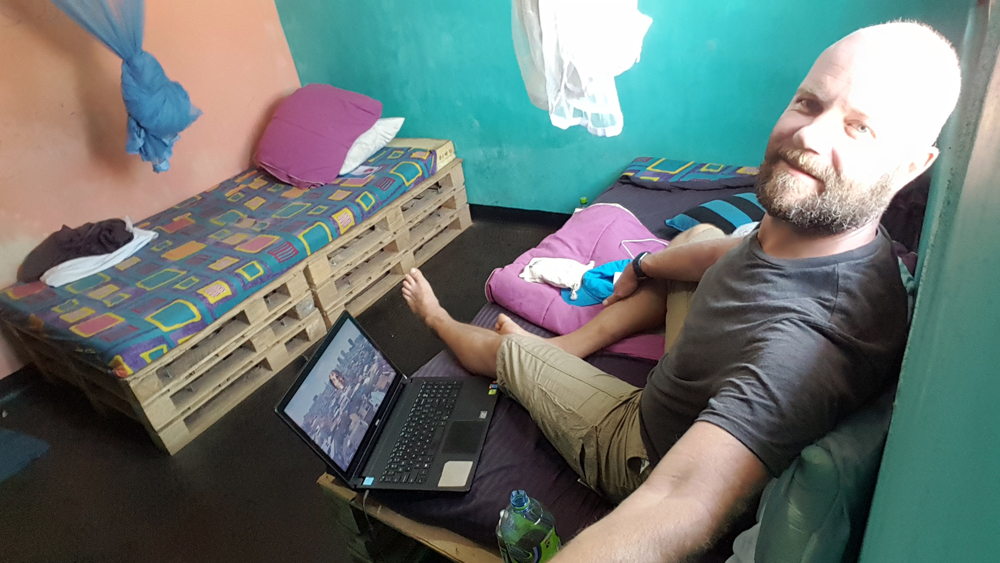
2018: My office in a hostel in Ella, Sri Lanka.

With that said, the internet can be an intimidating place. When I signed up with some platforms, I thought I would never survive this way. Look at all these people already going for these job offers! And they might be so much better than me! And look, their rating on their profile is going through the roof and I have nothing yet! That’s where I kept going. Everybody had to start at that same beginning. I scored jobs, I earned money, people rated me 5 stars and that earned me more jobs!

Below I have collected the 26 best job sites I have ever come across, with some additional information on each so you can find the best one for your needs. Some I use myself, others I have ran away from quickly.

I either got work from these sites, helped or referred others, or have colleagues who got long-term work from trusted companies through these job boards. Did I miss anything new and not listed here? Send it in the comments at the bottom of this blog.

Your remote income is only an app away.

  1. For remote working freelancers: Upwork.com.

Upwork is an American platform, used to be known as Elance in the past. Upwork connects businesses (the clients) with independent professionals (us freelancers) around the globe. It is the world’s largest freelance talent marketplace and that’s why I put it on number one. You can send a proposal to any job you see available. You get paid by Upwork once the job is finished and the client is happy.

Everybody starts at the beginning. And when I signed up I was a novice with no experience or rating on that site. I still proposed to job offers and slowly raised my rates. It took me six months to make a four-figure income per month through jobs I scored through Upwork.
www.upwork.com

  1. For Startups, Mostly US-Based: AngelList.

AngelList is basically like Match.com for startups, helping them get connected to both investors and employees. You’ll find 1000s of jobs here at some of the BEST startups around the world. It is very user-friendly and allows you to browse jobs by location, role, technology, and salary. Try this if you want to work at a start-up.
www.angel.co/remote

  1. For Creatives: Authentic Jobs.

This site is best for creatives. Enter ‘remote’ in the location box and you’ll get a list of full-time and contract-based (freelance) job opportunities for writers, designers, and other creative professionals.
https://authenticjobs.com/

  1. Blockchain Jobs: Cryptocurrency Jobs.

This site is the hotspot for finding blockchain jobs, cryptocurrency jobs, Bitcoin jobs, Ethereum jobs or, DeFi jobs. Absolutely not my niche, but worth a mention on this list. Filter for ‘remote’ in the location search block and get a whole list of blockchain jobs with startups for engineers, designers, customers support, sales, and marketing.
www.cryptocurrencyjobs.co

  1. Europe Based: F6S Jobs.

This site is focused on startups in Europe. It’s a home for founders and startup programs with thousands of jobs.
www.f6s.com

  1. For Contract-Based Jobs: Freelancer.

Freelancer is one of the world’s largest marketplace for freelancing and crowdsourcing. On this site, you can find work in software dev, writing, data entry, design, engineering, sales/marketing, accounting, and legal.
www.freelancer.com

  1. For Designers and Developers: Gun.io.

A site for full-time freelancers in software development, UI/UX, design, project management, etc. Based on your skills, the Gun.io team hand-matches you with clients.
www.gun.io

  1. For Freelancers: Guru.

Guru is a marketplace for employers and freelancers to connect, collaborate and get work done on a contract or one-off basis.
www.guru.com

  1. For Freelancers: Hubstaff Talent.

This site is a hub for remote startups, software companies, agencies, and e-commerce businesses looking to hire freelancers. Great place to find one-off projects and contract-based work.
https://talent.hubstaff.com

  1. A HUGE Job Board For Just About Anything: Indeed.

One of the biggest sites for job seekers where you can find pretty much millions of jobs online. Enter ‘Remote’ in the Where search box to access the list of remote job offers. Tip: You can set up job alerts to be notified by email whenever new jobs match your criteria.
www.indeed.com

  1. Diverse Job Board For Everyone: Jobicy.

Categorized remote job board with a diverse range of roles from sales and marketing to finance to programming and design.
www.jobicy.com

  1. A Curated Collection Of Job Boards: Jobkit.

A collection of job boards that you can filter by category (creative, freelance, remote, startup etc). Click on ‘Remote’ to view remote job boards.
www.jobkit.co

  1. For European Tech Pros: Landing.jobs.

A European online marketplace for folks in the tech field.
www.landing.jobs

  1. For anything: LinkedIn.

I suppose you already heard about LinkedIn unless you’re hiding under a rock. But did you know it’s not only for finding 9 to 5 office jobs? LinkedIn offers several remote and freelance positions as well.
www.linkedin.com

  1. For Freelancers: PeoplePerHour.

Online marketplace for freelance work and services. It’s like Fiverr, where you can set up your skills for anybody who needs to book them from you.
www.peopleperhour.com

  1. For Interpretation, Transcription and Translation Professionals: ProZ.com.

This site is the leading source for finding freelance translation, transcription and interpretation jobs. It took me over one hour from registering to get everything set up an once it did not accept my US bank account for payments while living in the European Union, I gave up the idea of ever working with ProZ.
www.proz.com

  1. For Latin Americans: RemoteCo

This site is dedicated to connecting SMEs to remote workers in Latin America.
www.remoteco.com

  1. For All Things Remote Work: Remote Co.

Remote companies, remote workers, remote work articles, online courses, remote jobs, career coaching and so much more for remote workers.
www.remote.co

  1. Diverse Job Board For Remote Work: Remote Ok.

Categorized high-quality remote job board with a diverse range of roles. Roles range from sales and marketing to finance and legal to programming and design.
www.remoteok.com

  1. Diverse Job Board For Remote Work: Remote Work.

Categorized high-quality remote job board with a diverse range of roles. Roles range from sales and marketing to finance and legal to programming and design.
www.remote.work

  1. Diverse Job Board For Remote Work: Remotive.

A robust job board for roles in about every industry. You can find work for every niche, including sales, finance, design, and tech.
www.remotive.com

  1. For Developers: TechMeAbroad.

TechMeAbroad only lists jobs from tech startups and companies offering visa sponsorship. Find the job of your dreams, in the country of your dreams.
www.techmeabroad.com

  1. For Anyone: The Muse.

Enter ‘Remote’ in the Location search box and select ‘Flexible/Remote’ to access a wide range of remote and location-free jobs in any field.
www.themuse.com

  1. For Developers, Designers and Finance Professionals: Toptal.

Exclusive network of the top freelance software developers, designers, and finance experts in the world. And when I say The Top, they mean the top 3% best of them. They provide access to top companies, a community of experts, and resources that can help accelerate your career.
www.toptal.com

  1. For Interpretation, Transcription and Translation Professionals: TranslatorsCafé.com.

My bilingual friends love using this site to find remote translation and one-off projects. Interpretation, transcription, and translation freelance jobs. The site’s design will bring you back to 1995, so don’t be afraid to slowly take it all in. This ain’t 2022 anymore, Toto.
www.translatorscafe.com

  1. Huge Remote Database For Anyone: We Work Remotely.

One of my go-to favorites. On this awesome site, you can find remote (fulltime) jobs in marketing, design, programming, customer support, DevOps and sysadmin, copyrighting, business/exec, and management. Companies pay already $299 to post one job on it, so that seriously raises the bar for everybody.
www.weworkremotely.com

You can leave a comment on this blog if you scroll down.