
About Ramon
Hi, I’m Ramon Stoppelenburg. I’ve spent most of my life testing how far curiosity can take you — across countries, ideas, and the occasional questionable plan.
You might know me from Letmestayforaday, from the movie houses I ran in Cambodia, from something I wrote, or not at all. These days, I split my time between writing, translating, consulting, media training across Southeast Asia, and building projects that tend to start small and grow in unexpected directions.
This page answers the questions people tend to ask once they realise I didn’t exactly take the standard route.
Use the shortcuts below if you’re looking for something specific.
- The Letmestayforaday Story
- Travel & Living Philosophy
- Professional Work
- Practical Advice & Working Together
The Letmestayforaday Story
What was Letmestayforaday?
It started as a simple question: what happens if you trust strangers completely?
In 2001, I began traveling the world without money, asking people online if I could stay for a day in exchange for a story. There was no social media, no Couchsurfing, no blueprint. Just a website and a lot of optimism.
It grew quickly. Invitations came in from everywhere. At some point I stopped feeling like a traveler and more like someone being passed around a global network of generosity.
How did it actually work?
I asked for three things: a meal, a place to sleep, and a bit of time. In return, I wrote about the experience. That was it.
What surprised me wasn’t that people said yes — it was how often they did.
What stayed with you most?
Not one moment, but the contrast. Eating raw fish with an Inuit family in the Arctic one week, ending up in a chaotic student house in Australia the next. Different worlds, same openness.
Why did you stop?
At some point, the story started to take over. People weren’t just hosting me, they were hosting the idea of me.
I had proven what I set out to prove. The world is far more generous than we think. After that, I wanted to go back to being a person again, not just a project.
Do you still keep in touch with people from that time?
Yes. Some of those one-day stays quietly turned into long-term friendships. That might be the most unexpected part of it all.
Travel & Living Philosophy
Where did this urge to move come from?
I was born in Jakarta and grew up in a quiet Dutch village below Rotterdam. That contrast never left. I knew early on that the grass was actually greener elsewhere.
My first solo trip at seventeen confirmed it. Since then, staying still has never felt like the default.
Why keep moving?
Because every place reshapes you a little. New languages, different rhythms, other ways of thinking. It keeps things sharp.
Also, I like the idea that life doesn’t have to settle into one version of itself.
A place that stayed with you?
Kugluktuk, in the Canadian Arctic. Remote, quiet, and completely stripped of distraction. The kind of place that forces you to pay attention again.
Why Cambodia?
I came here in 2008 and saw something I didn’t see elsewhere: space. Not just physical, but mental. And many possibilities.
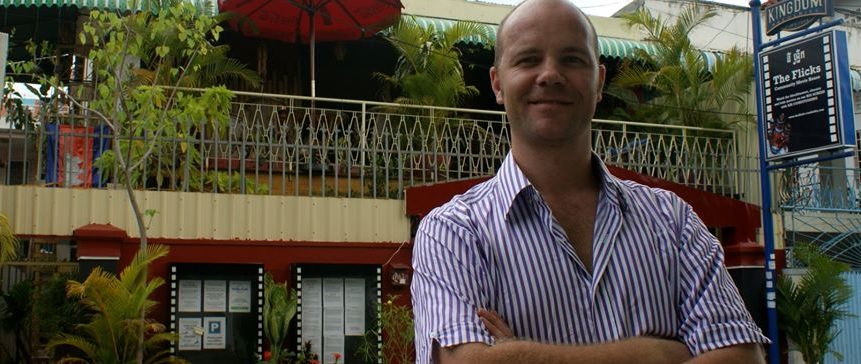
I moved definitely in 2010, bought a small ‘festival movie house’ (as the sign above the villa entrance displayed) a year later with money I didn’t have yet, fundraised money before GoFundMe even existed, and built a life around it, ending with three art house movie theaters all around town.
It’s not always easy, but Phnom Penh gives me room to create. That matters more than comfort.
Languages?
Dutch and English fluently. Enough French, German, Italian, Spanish, and Khmer to get by. Living somewhere tends to be the best teacher.
Professional Work
What do you actually do?
I write, edit, build things, and spend a significant part of my time as a media trainer across Southeast Asia, working with organizations and individuals on how to communicate clearly under pressure and in front of an audience.
My background is in journalism. Over the years I’ve written for newspapers, magazines, and online platforms, published a book, and started more projects than I can neatly categorise.
And the consulting work?
I tend to work with hospitality businesses that aren’t quite working yet.
In Sri Lanka, I walked into a restaurant that was empty most nights. A few months later, they were turning people away. No big strategy decks, just fixing what didn’t make sense and building from there. I like practical work. Less talk, more change.
What else are you involved in?
I run and develop the Phnom Penh Passport, a city-wide concept built around discovering independent venues and creating a more connected local scene. It sits somewhere between publishing, community-building, and a quiet push against forgettable places.
You were involved in disaster relief?
After the Lombok earthquakes in 2018, I helped coordinate aid by creating a simple app that allowed people to mark where help was needed. It wasn’t planned. It just felt like the most useful thing to do at the time.
Ever considered a normal career path?
I tried it briefly. It didn’t stick.
Practical Advice & Working Together
Advice for starting something unconventional?
Start smaller than you think you need to. You don’t need a full plan. You need a first step that actually happens.
For travel or business ideas?
Test it early, test it cheap, and pay attention to what works instead of what you hoped would work.
Do you take on projects?
Yes, selectively. I work best with people who want to fix things, not just talk about them. If that’s you, reach out.
Where can people follow your work?
If you’re curious about what I’m doing right now, the Now Page is usually the most accurate place.
Still Have Questions?
If something’s missing, feel free to reach out. I still believe most good things start with a simple message from one person to another.
— Ramon